SILVERITE
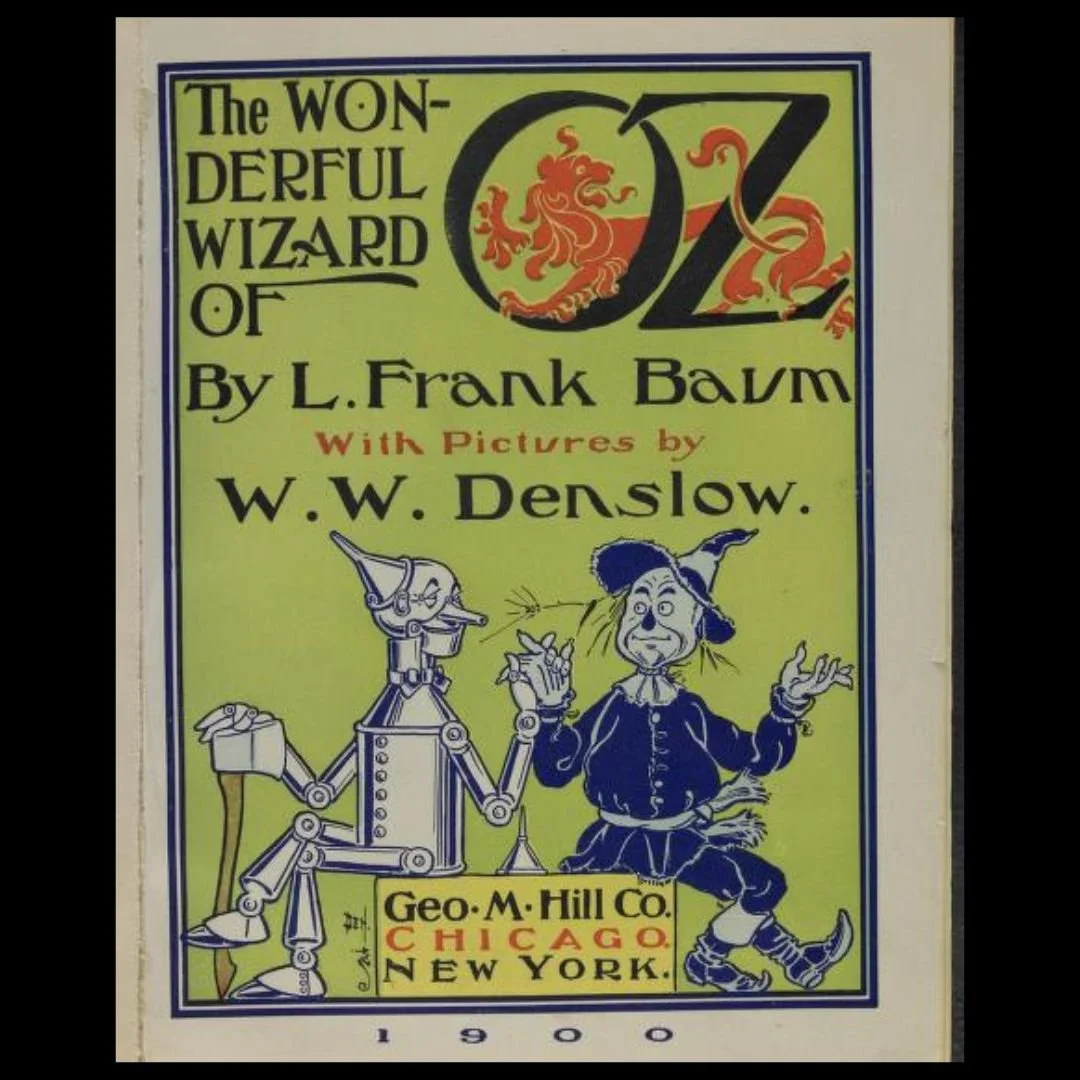
Image of page from The Wonderful Wizard of Oz, (1900), Baum, L. F., Denslow, W. W., Meyer, Chicago; New York: Geo. M. Hill. Co., courtesy E. R. & Aramont Library Collection, Retrieved from the Library of Congress.
“This strange place cannot be Nebraska”, the big man says. He surveys the fields of blue-tinted rectangular sections of glass, row upon row, blanketing the earth like a swimming pool. He loosens his string tie under the brilliant sun, lifts his right hand up to shield his eyes.
“Where am I?” he says aloud, pushing up the sleeves of his dark alpaca suit and white dress shirt. He looks back toward the train depot—but there are no passengers, no workers, and no sign. Just a forlorn building, next to a set of tracks.
Suddenly, a tall, willowy woman appears drifting in the air above the ridges of blue glass. She’s wearing a burnt-orange gown; the hem flutters as she floats toward him. She is carrying an ornate gilded birdcage in her left hand. The sun catches the glitter of her silver platform shoes. The woman lands gracefully before him, and he wonders if she is an angel; but he does not fear her, for he is a godly man.
The woman has long, dark blonde hair, with dramatic bangs. Her makeup is paradoxically glamorous, yet understated: black, cat-eyed liner, red lipstick, and a bare face. Her vibrant eyes are the color of the reflective pools that are propped up in orderly rows all around him.
“You are not in Nebraska,” she confirms.
“Well, where am I then?” he asks.
“You are in Illinois,” she says melodiously.
“Illinois, is it? Where in Illinois?”
“Salem,” she says.
“This can’t be Salem,” he remarks, perplexed, eyeing the eerie blue panels all around him. “Salem is my hometown; but none of this looks familiar to me.” He pauses, takes out a kerchief, brushes the sweat from above his thick eyebrows. “How did I end up here?”
“Oh,” she says. “It’s simple, really. The AI train was passing by; and, when it stopped, you stepped off onto the platform. Salem must be where you wanted to be, I suppose.”
“I assure you, ma’am, I had no desire to stop in Salem,” the man insists, bristling. “I was on a train bound for Lincoln. I have no idea how I ended up here.”
“Lincoln?”
“Yes. Lincoln. Nebraska. I was heading home. You see, I’ve been touring for weeks across this great nation, giving speeches at various stops along the way. I am running for the presidency. I’m sure you have heard of me, no doubt. I’m William Jennings Bryan.”
The woman looks at him blankly, unblinking.
“I’m an attorney,” the man continues, his voice sonorous and powerful. “A former congressman. A celebrated orator. I’m known as the Great Commoner. Surely, you’ve heard of me?”
“Oh, I’m afraid not,” the woman says. “You’re running for President? President of Salem?”
“No,” he says. “President of the United States.”
He hands her a campaign button, and she stretches out her right hand, takes the button, looks at it for a second or two with mild interest, and then affixes it to the birdcage. For the first time, the man notices that there is not a bird inside of the cage, but rather a fussy-faced orange tabby cat dressed like a king’s squire.
“Why are you in Salem?” the woman asks.
“Well, that’s precisely what I’m trying to ascertain myself, ma’am,” he says. “I’ve been campaigning throughout the Midwest, and have made many stops along the way; but I assure you, I had no intention of stopping in Salem.”
She smiles knowingly. “Oh, but you see, Mr. Bryan, you must have wanted to return here. That is probably the reason why the AI train dropped you off here. It knew you wanted to come to Salem.”
“Why would I want to come back here? I haven’t been here since I was a child.” He takes in the rows of blue panels, wipes his brow with his kerchief again. “This looks nothing like the town as I remember it. Are you certain this is Salem, Illinois?”
“Oh, yes,” the woman says. “I’m certain.”
“Do you know when the next train is coming?” Bryan asks impatiently.
“I’m afraid, I do not.”
“Okay, well who’s in charge around here? Is there a sheriff or a mayor, perhaps?”
“Oh, I don’t know that either,” the woman replies pleasantly.
“May I ask, who are you, ma’am? You seem to have just appeared out of nowhere.” He pauses, frustrated and perplexed. “I am not dead, am I, and standing before an angel?”
“Oh, no,” she says, smiling serenely. “You are not dead; and I am not an angel. I am Royal-T, the Good Billionaire of the East.”
William Jennings Bryan recoils, stunned. “Did you say, billionaire?”
“I did,” she says.
“Billionaire!” he exclaims indignantly. “Why would any person need that amount of money?” Without letting her respond, Bryan continues: “Royalty, eh? Your parents named you well, I suppose. And of course, you’re from the East; that comes as no surprise. But tell me, Miss Royalty, what is it that you do, ma’am, which has led you to acquire such a sizable fortune?”
“I write poetry,” she says dreamily, “and songs.”
“A poet? Like Edna St. Vincent Millay?”
“So, my friends would say,” Royal-T says.
“Envy tends to create more foes than friends,” he observes, but then moves on. “Well, for what it’s worth, I personally place a high value on words. That said, I don’t believe that any man, or woman, for that matter, is deserved of the accumulation of such massive wealth.”
“I use my wealth to spread joy throughout the world with my poems and my songs,” she says, smiling contentedly, and seemingly unbothered by his criticism.
“At least you are using your money for good, by your own account; though I still have no idea how any one person could possibly be worth a billion dollars. Quite absurd, in my estimation!” He wipes his brow, looks frustrated, gestures to the rows of blue glass. “What are all these strange windows, covering the soil? When I was a boy here in Salem, there were farm fields all across this area. What are these odd structures blemishing the earth?”
“I’m afraid I don’t know,” says the Good Billionaire of the East; and she suddenly rises up, along with her cat in the cage, and disappears.
Simultaneous with her departure, one of the blue sheets of glass stands up from the ground, revealing itself in human form, with arms, legs, torso and face.
“These are solar panels,” the strange figure says, spreading his arms out wide, gesturing to the rows.
“Who are you?” William Jennings Bryan bellows.
“I am Solar Panel Man.”
“And those. . . ?” the presidential candidate points to the rows of blue glass.
“. . . Are hundreds of acres of solar panels,” Solar Panel Man explains.
“Solar Panels, you say? Good heavens, what is the purpose of these solar panels and why are there so many of them?”
“Solar panels are used for energy,” Solar Panel Man replies robotically. “The panels provide an alternative power source for homes and businesses.”
“So where are the cornfields and rows of wheat that used to stretch out as far as the eye could see?” Bryan demands. “What happened to the bucolic farms of Salem that my memory holds?”
“These are farms,” Solar Panel Man says. “They’re solar farms.”
“They look like commercial structures to me,” the Great Commoner comments. He impatiently returns to his attempt to find his way out of Salem. “Well, whoever, or whatever, you are, can you tell me, who’s in charge around here?”
“In charge?”
“Yes, like a mayor or a sheriff, perhaps? Or even a train conductor? You see, I must have exited at the wrong stop. I was on the train, headed home to Nebraska; but somehow, I ended up here. I am not quite sure how.”
“Well, this must be where you wanted to be,” the Solar Panel Man says.
“Are you not listening to me?” William Jennings Bryan says, wipes his brow again with his kerchief. “I am trying to find my way home.”
“Well, perhaps this is your home.”
“This, I assure you, is not my home,” the politician says, scoffing. “Salem used to be my home, many years ago, when I was a child, but it bore no semblance to this. . . most unusual and quite horrid-looking place.”
“Well, the AI train is never wrong,” the Solar Panel Man insists. “It’s foolproof. You must’ve willed yourself here to Salem. Otherwise, the AI train wouldn’t have dropped you off here.”
“AI train?” Bryan asks, perplexed. “I have no idea what you mean by that. What is an AI train?”
The Solar Panel Man does not answer him; but instead looks apprehensive. He buckles down, almost as if he were melting, and returns to his original inanimate form, joining indistinguishable rows of obsequious solar panels. Just as he morphs away into immobility, a strong gust of wind stirs up a ferocious dust devil. William Jennings Bryan covers his eyes with his hands, but when the whirlwind passes by, he is left covered with a layer of dust and debris. He attempts to brush the silt off his suit jacket, sneezes and coughs, turns around, and stumbles toward the train depot through the hazy plume of dust. He is dismayed when he sees the station is gone altogether.
“But what is this?” he bellows. “The depot is gone? How is this possible?”
Emerging from the dusty air, appears a stunning dark-haired woman, wearing a long, sparkly, golden body-hugging gown. She has large brown doe-eyes, high arched eyebrows, curvaceous hips, and a narrow waist.
The Great Commoner wonders if this is another angel.
“Who are you?” he demands, with clear and strong timbre. “An angel?”
The woman laughs. “I am no angel. I am the Bad Billionaire of the West.”
“Bad?” he asks. “A witch then, I take it?”
“Oh, no, no, no,” she corrects him, displaying the most dazzling of white smiles. “Bad as in cool, not bad as in evil. I’m not a witch at all. Like I said, I’m a billionaire.”
“Is this now a land of billionaires?” he ponders aloud, but before the woman can answer, he asks her directly, almost derisively, “And how did you amass your fortune, ma’am? Poetry?”
“No,” she says. “I’m an influencer, an entrepreneur, and a reality TV star.”
“This is a most odd place, indeed,” Bryan mumbles to himself; and then, to the Bad Billionaire of the West, he says, “I am familiar with the term entrepreneur; but have never heard of the other two occupations you referenced. Shall I refer to you by your title, or do you have a name?”
“You can call me Mikee.”
“A pleasure, ma’am,” he says. “I am William Jennings Bryan, candidate for the office of the President of the United States.”
As he introduces himself to her, he hands her one of his campaign buttons. She doesn’t look at the pin, but instead simply tosses it toward the solar farm fields.
“I prefer gold, sir, to silver,” she says.
“A goldbug, are you?” he asks.
She shrugs. “Call me what you will. Gold is the standard I choose to live by; unlike my foe, the Good Billionaire of the East. She’s a free-silver fan, like you.”
“I take it that you know who I am, then?” he asks.
“Of course,” she says with slight disdain. “You are the Great Commoner, the Silverite. I am familiar with your Cross of Gold speech. Such a sappy, yet effective, appeal to the masses! But as a self-made Billionaire, I could do without all of the sanctimonious preaching and demagoguery.”
Irritated, not humbled, Bryan says, “Very well, then, ma’am, can you tell me, where I may find someone who is in charge of Salem?”
She sighs, studies her long fingernails, and then points to a roadway that has appeared among the solar panels. “You just follow the Bitcoin Road,” she tells him.
Puzzled and somewhat amazed at the sudden appearance of a slick, glassy roadway, he remarks, “I was just near that path a moment ago, and it was dirt. It looked nothing like it looks now.”
“As I was saying, just follow the Bitcoin Road,” she repeats.
“Bitcoin, you say?” he asks, confused. “What is Bitcoin?”
“It’s digital currency—something that a populist, anti-establishment, silverite, such as yourself, would surely understand.”
“I have never heard of this term, ‘digital currency,’” he says, waiting for an explanation.
She sighs, looks annoyed, does not provide him with any further details. “Just follow that road,” she says. “Call it whatever you like. Personally, I would prefer that it was a gold road, and not a Bitcoin Road, but that’s just me.”
It is evident she is not going to engage any further, so he turns and treads, trepidatiously so, over the slippery surface. He only travels a few yards, when a clown-faced scarecrow approaches him on an electric bike, traveling at a high rate of speed. The scarecrow veers head-on toward him, and Bryan darts over to the shoulder of the road, to avoid getting run over. He slips on the slick roadway, but manages not to fall. The scarecrow rider zips away, cackling loudly, and disappearing.
“I forgot to mention: watch out for the electric bikes!” the Bad Billionaire of the West calls out to him. “They’re everywhere on the Bitcoin Road!”
“Quite hazardous, indeed!” William Jennings Bryan mumbles loudly to himself, turns and continues walking away from Mikee. “Oh, how I dislike bicycles!”
He continues striding, stately so, away from Mikee, and walks for nearly an hour under the hot sun, before he encounters a man dressed as a lion, heading toward him. As the lion-suited man approaches, it is evident that the costume is way too big for the man’s gaunt frame, and that it is worn and ragged. The man is obviously under the influence of intoxicants, for he is stumbling and staggering down the roadway. He nearly inadvertently bumps into William Jennings Bryan as they pass by each other.
“Good Heavens, sir, are you drunk?” Bryan exclaims.
“Drunk?” the lion-suited man slurs, stopping to look at him. “No, I’m not drunk. I’m stoned.”
“Stoned? What do you mean, sir?”
The man evidently finds this question to be hilarious, for he breaks out in loud laughter. When he composes himself, he wipes away tears, and says, “I’m high, man.”
Appalled, Bryan demands, “What has caused you to be in this public state of intoxication?”
“That would be weed, sir.”
“Weed, you say? Is that some sort of alcohol?”
“No, man; don’t you know, no one drinks anymore,” the lion-man says. “Where are you from anyway? You sure are dressed funny.”
“I would say the same for you, sir,” Bryan says, indignant. “You’re the one wearing a lion costume.”
“No, seriously, like I haven’t seen a man dressed in a fancy suit like that in Salem in . . . well, forever, I guess. You’re not from around here, are you?”
“I lived here a long time ago, as a boy. But I assure you, this place bears no semblance to the place of my childhood. As for where I hail from now, I live in Lincoln. I am trying to return there; but for some strange reason, the train depot seems to have disappeared. I am hoping if I find a mayor or someone else in a position of authority around here, that I can board the train and go home to Lincoln.”
“You are trying to get to Lincoln?”
“Yes, Lincoln, Nebraska,” he says. “I want to go home to Lincoln.”
“Well, there’s the train depot, right behind you,” the lion-man says, pointing.
The silverite turns around, befuddled. “But that can’t be!” he exclaims, confused. “Not that long ago, I was talking to a woman right near the spot where the train had dropped me off, but the depot was gone. It had completely vanished. I’ve been walking for nearly an hour from the place where it once stood. How is it possible that it is right behind me now? I didn’t pass the depot when I was walking down this road. I am sure of it.”
“It’s an AI train, dude,” the lion-man explains. “It came back to pick you up because you wanted it to. You said you wanted to go home to Lincoln, so it came to get you.”
“An AI train, you say? What does that mean?”
“Look, it’s not rocket science, mister. It’s just artificial intelligence, plain and simple. You said you wanted it to take you back home to Lincoln, so here it is.”
A conductor steps out of the train and calls out from the platform, “All aboard, to Lincoln, Nebraska!”
William Jennings Bryan shakes his head, stumped. He thanks the lion-man, and strides over to the depot. Before he boards the train, he stands near the conductor, turns around briefly to look back at the frightening place behind him. He glances at the rows of solar panels, the intoxicated man in an oversized lion suit staggering along the Bitcoin Road, and several reckless scarecrows careening down the pathway on electric bikes.
“I never want to return to this strange land,” William Jennings Bryan announces aloud. “A most curious place, indeed! What could possibly be the origin of its species?”
“Hey, aren’t you William Jennings Bryan?” the conductor asks him.
“I am indeed,” he says, handing him a campaign button. “William Jennings Bryan, candidate for the office of the Presidency of the United States.”
“What is a famous man like you doing in Salem?” the conductor asks.
“I’m asking myself that same question,” the Great Commoner says pensively, and starts to board the train, as if apprehensive that it might leave without him. Once he is standing on the steps of the interior, he turns around and adds, “I’m afraid I don’t know how I ended up here. But I’ll tell you this, good sir; I’d rather lose the election for presidency three times over than ever come back to this place. That much I do know!”
SILVERITE was awarded second place in the 11th Annual New Deal Writing Competition, sponsored by the Genesee Valley Council on the Arts in New York. The ekphrastic writing competition sought stories that were inspired by “The Wizard of Oz,” a painting by Ruth Harper. Harper’s painting contains visual imagery relating to the famous 1900 novel, “The Wonderful Wizard of Oz,” by L. Frank Baum.
SILVERITE, Copyright © 2026 by Donna Kathryn Kelly